There are two types of this machine, classified as:-
Horizontal milling machine.
Vertical milling machine.
The name is after the spindle axis position.
If the axis is horizontal, the machine is horizontal milling machine. If the axis is vertical then the machine is vertical milling machine.
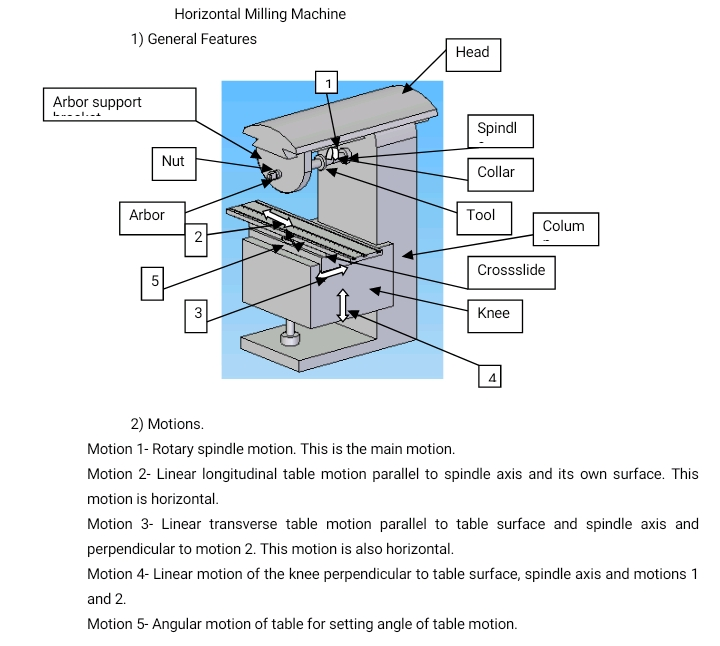
2) Motions.
Motion 1- Rotary spindle motion. This is the main motion.
Motion 2- Linear longitudinal table motion parallel to spindle axis and its own surface. This motion is horizontal.
Motion 3- Linear transverse table motion parallel to table surface and spindle axis and perpendicular to motion 2. This motion is also horizontal.
Motion 4- Linear motion of the knee perpendicular to table surface, spindle axis and motions 1 and 2.
Motion 5- Angular motion of table for setting angle of table motion.
3) Work Holding.
Directly on the table.
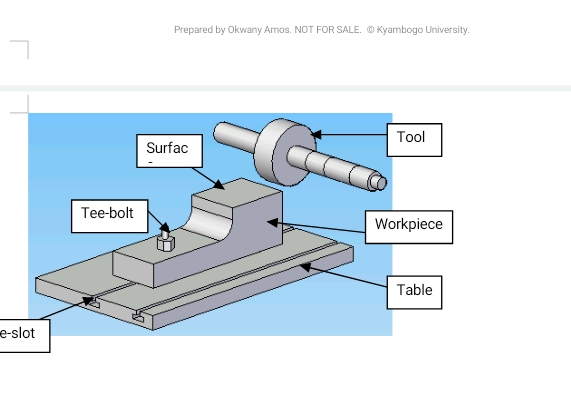
The tee-slots on the table are used to hold the work directly on the table using either clamps, for work pieces without holes or only tee-bolts, for those with holes.
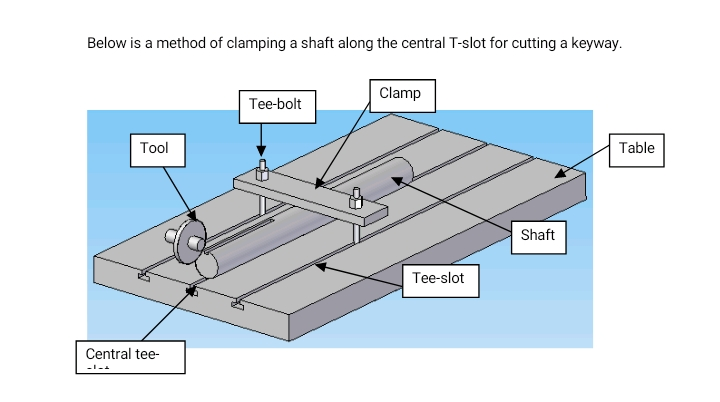
The central tee-slot is machined very accurately parallel to motion 2 and perpendicular to motion 3. It can therefore be used to align a job during clamping and the job automatically aligns with those motions. For example, a shaft can be clamped along the slot for cutting a keyway and the keyway will be parallel to the shaft axis.
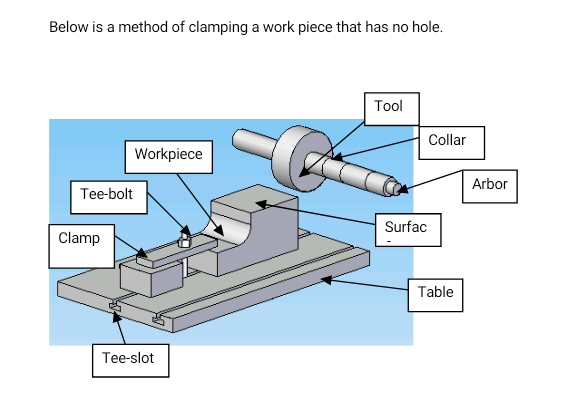
Below is a method of clamping a work piece that has a hole.
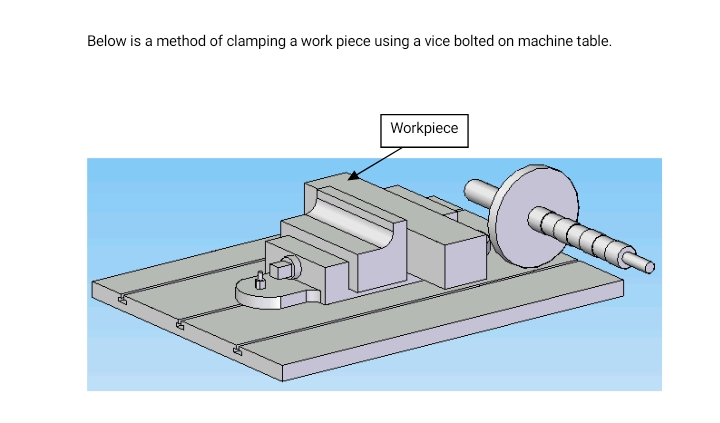
Machine vice.
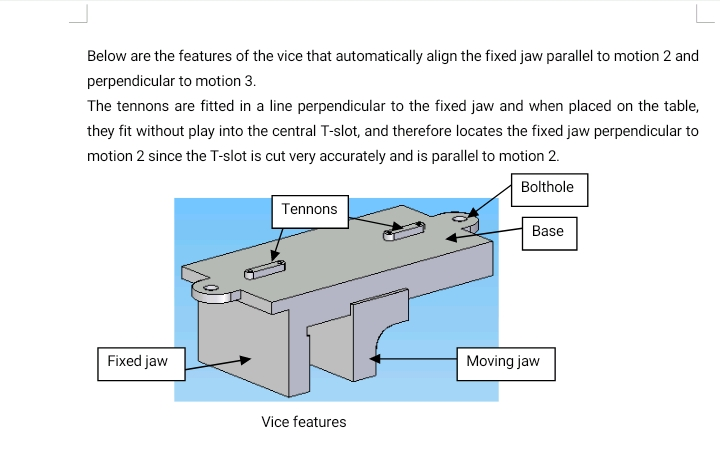
The vice has holes, which are used for bolting it onto the table, and then the work piece can be conveniently held in it.
The base of the vice is machined very flat and accurate. The surface held in the fixed jaw is always perpendicular to the base of the vice. There are two tenons at the base of the vice, placed accurately along a line perpendicular to the fixed jaw. The tenons also fit exactly, without clearance in the central tee-slot, such that when the vice is on the table, with the tenons in the central tee-slot, the fixed jaw is automatically aligned perpendicular to motion 2 and parallel to motion 3. The vice therefore becomes part of the table and automatically blends in the machine alignments. This gives correct geometry to any surface machined on a work piece held in a machine vice.
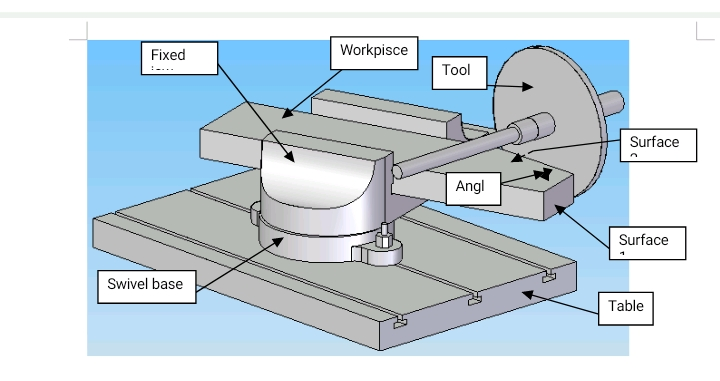
Swivel base vice.
In addition to all the features on the machine vice this vice has a base, which can be swiveled accurately at angles up to 180 degrees. This makes it possible to machine two or more surfaces at some angle to each other after the vice is bolted onto the table.
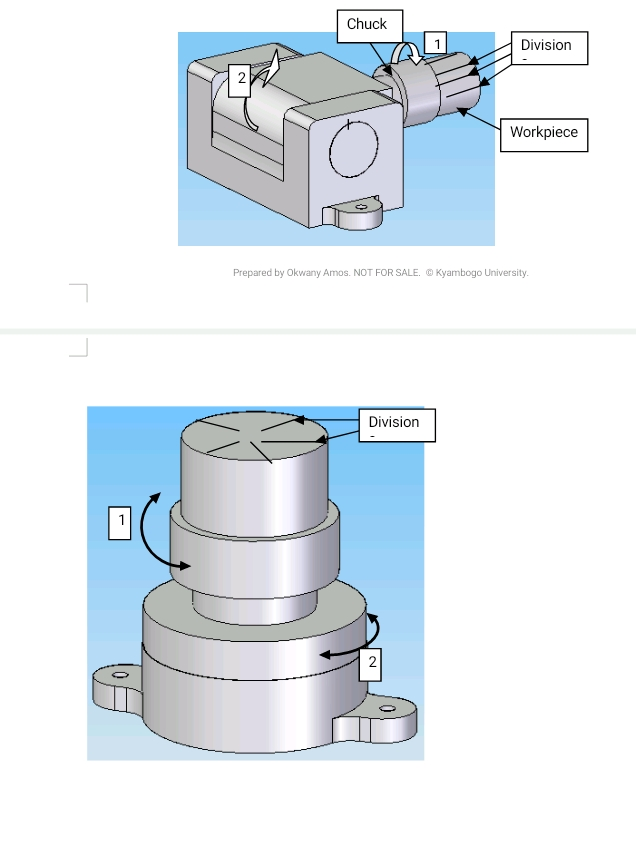
Dividing Head. All the features at the base of the vice are also on this device. Ones bolted on the table and the work clamped in its jaws it is possible to rotate the work about its axis and locked it in any position with considerable degree of precision in degree or number of turns or fractions of a turn. The work axis can also be turned and clamped in any position between horizontal and vertical. This increases the number of possibilities of producing surfaces at some angle to each other.
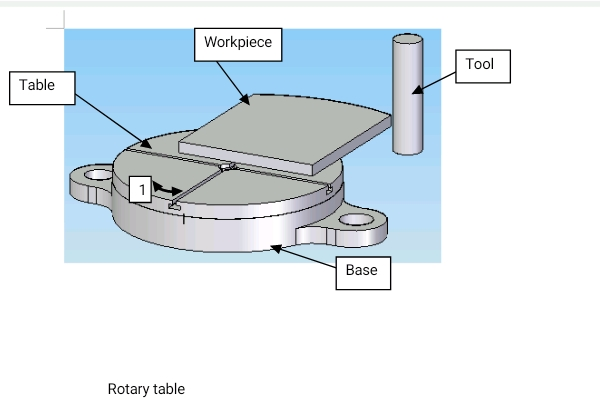
Rotary Table.
The base is also provided with the same features as on the dividing head. It is however a table which can be rotated about an axis perpendicular to the table base and locked in any position between zero and 360 degrees, very accurately.
The table has tee-slots on it for bolting or clamping the work piece onto it.
4) Tool Holding.
Most of the tools used on this machine are held on the arbor. The arbor itself is held in the spindle nose where there is a matching taper. A draw bolt is passed through the back of the spindle to hold the arbor in the taper. The taper serves to automatically align the axis of arbor to that of the spindle. The drive from the spindle is given positive drive through tenons at the spindle nose and from the arbor to the tool through the key, which runs the whole length of the arbor. The tool is finally held in position between collars by a nut at the end of the arbor.
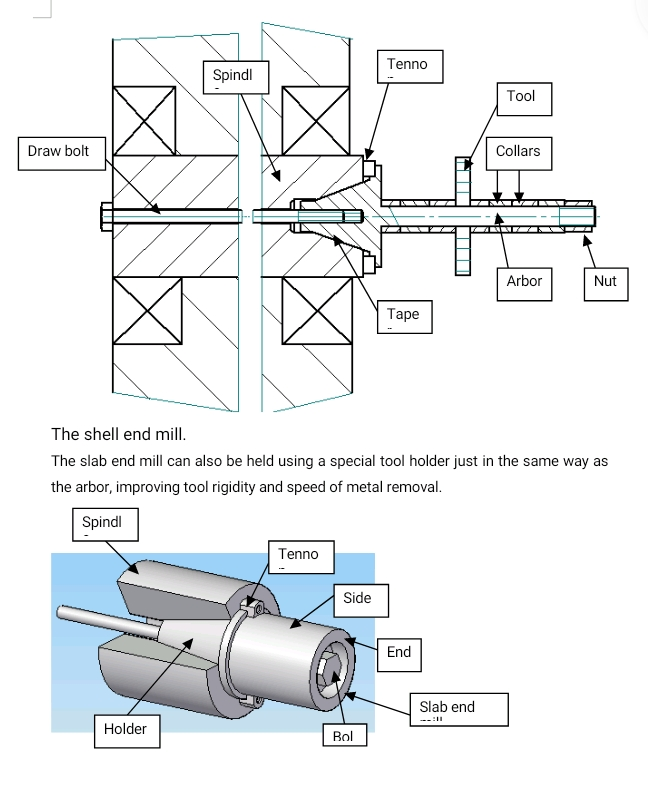
Operations.
The result of all operations is always a surface of some form produced. This comes about as a generated surface using single point tool or copying the form from the tool onto the work piece.
In both cases it is possible to produce a surface only if at least two motions of the machine are present at the same time. These are active motions, one of which must be spindle rotation, which is the main motion. Another motion, which is very important but does not exist during actual cutting process is the one used to set the cutting depth. This is passive motion. It is the motion used to give the work piece its size.
Milling.
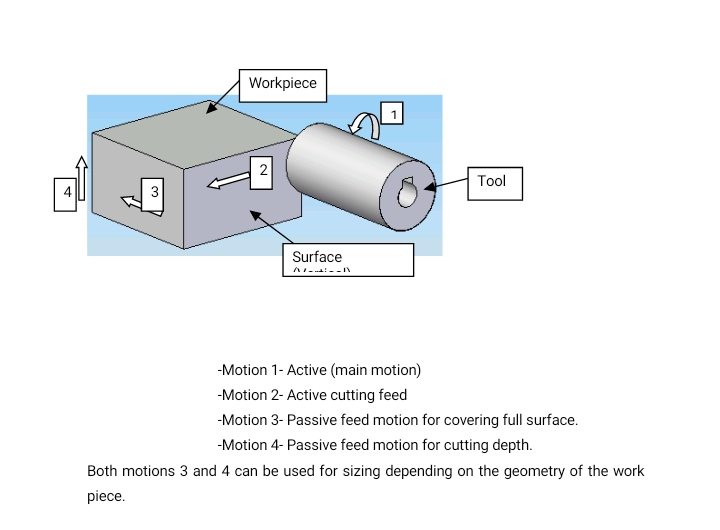
This machine is designed to produce mainly flat surfaces which are parallel, perpendicular or at some angle to each other. Surface orientation can be horizontal, vertical or at some other angle. The tools used to produce the surfaces have their cutting edges parallel to either the horizontal plane or the vertical plane or some other standard angle, usually 30, 45 or 60 degrees. The operation for producing all these surfaces is called milling, and the same operation can be done using different types of tools combined with different types of work holding methods. The most types of tools used for these are:-
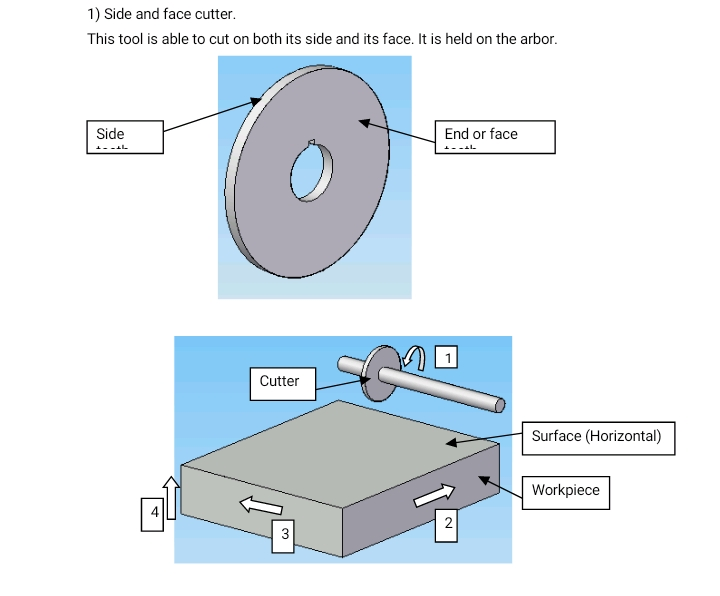
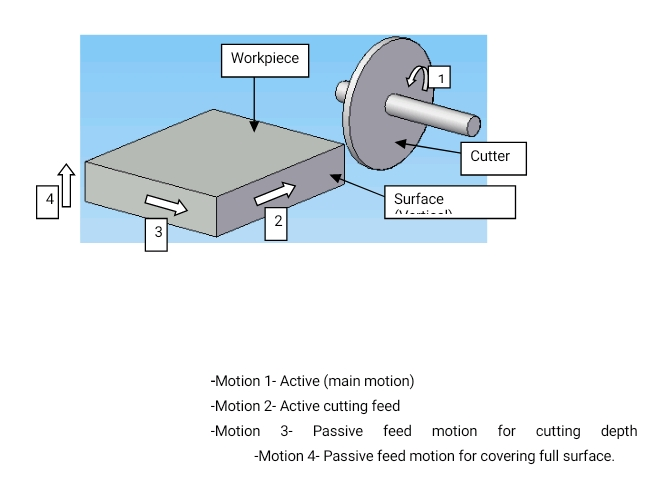
2) Slab cutter.
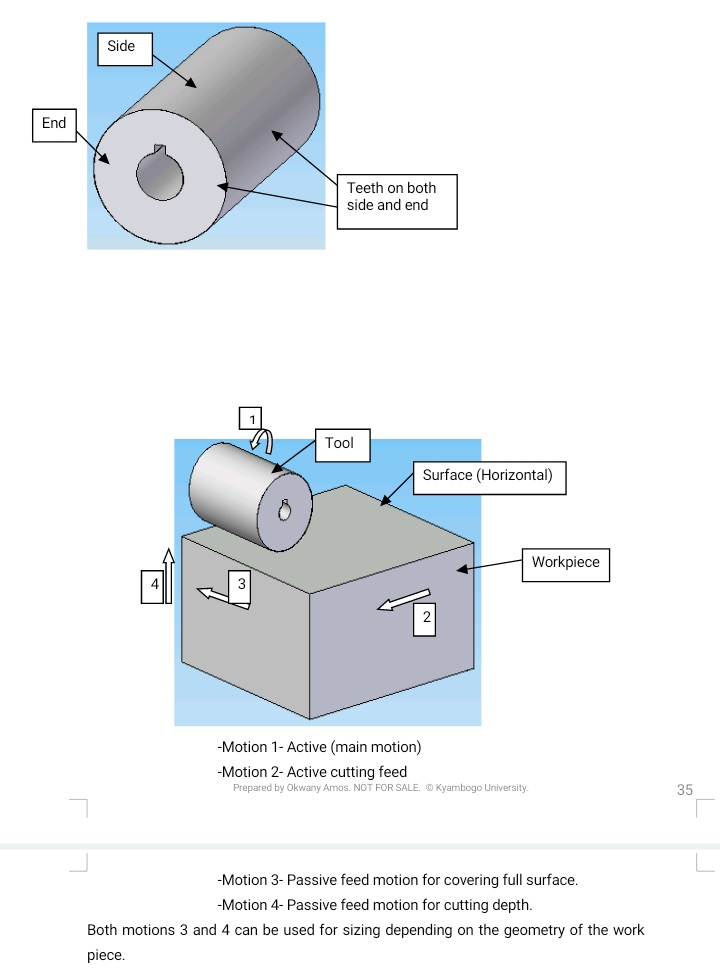
This tool has cutting edges only on its side. It is held on the arbor and therefore can mill only horizontal surface since the cutting edges are parallel to the horizontal surface.
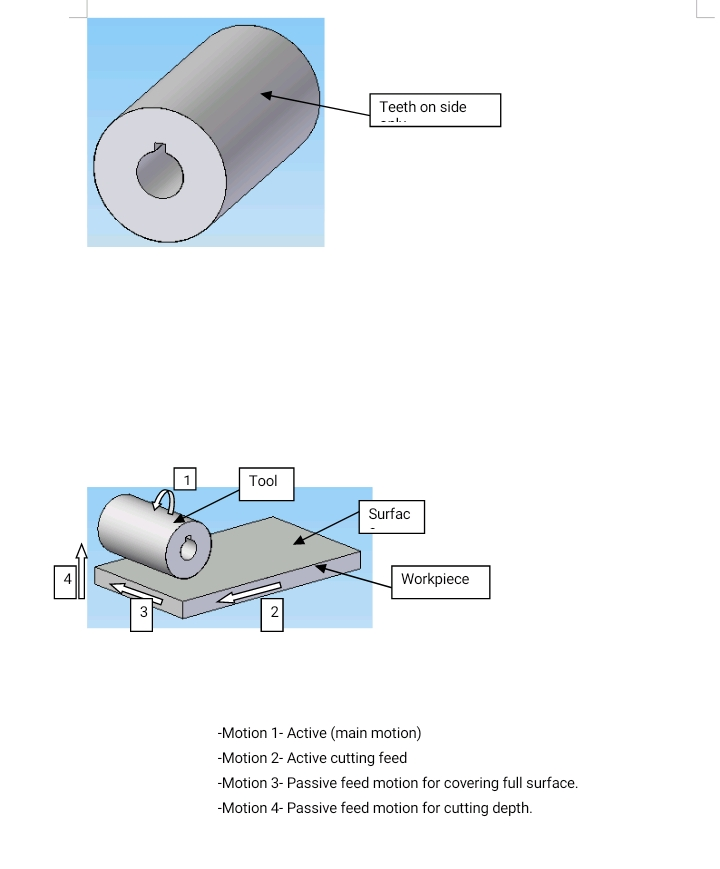
3) Shell End Mill
This tool is held using special tool holder, and on the machine, the cutting edges on the side cut horizontal surface and those on the end produce vertical surface.
Slotting and Slitting.
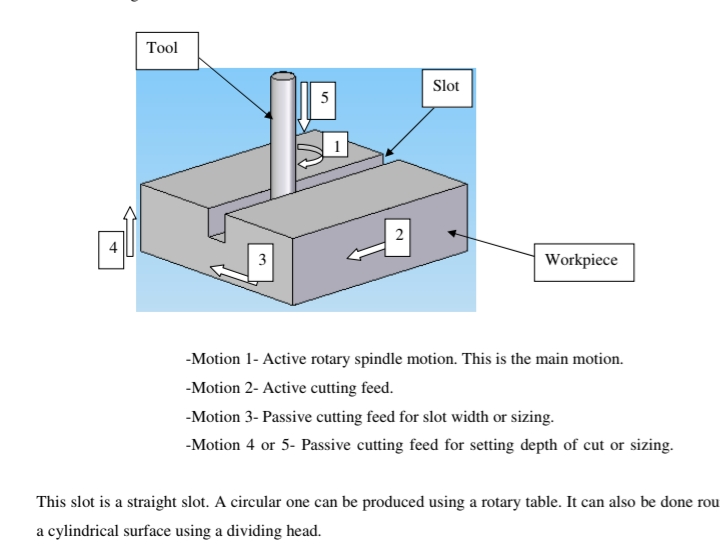
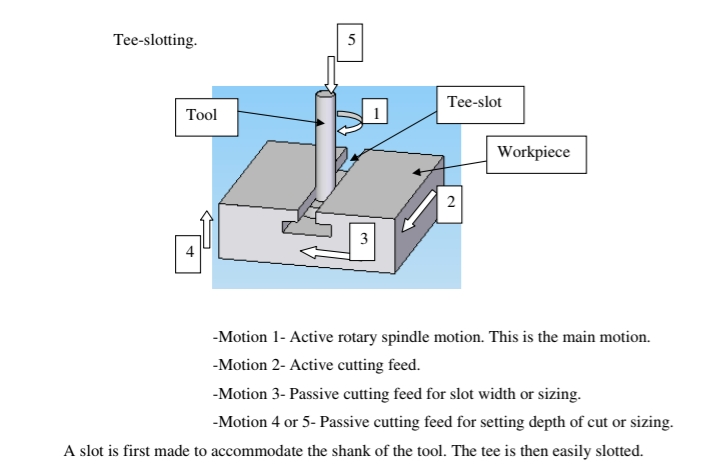
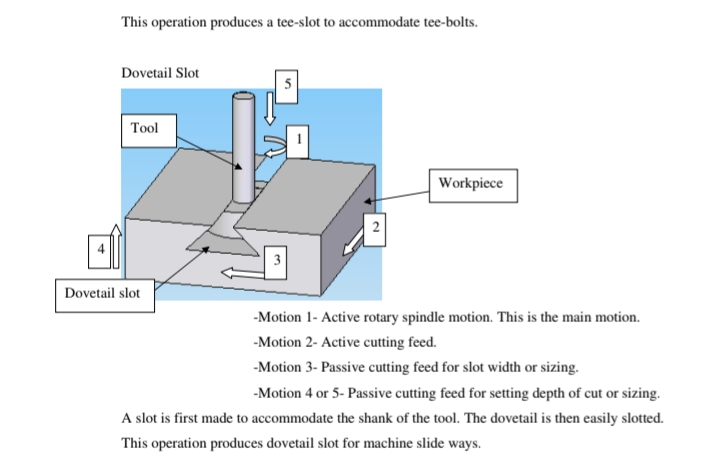
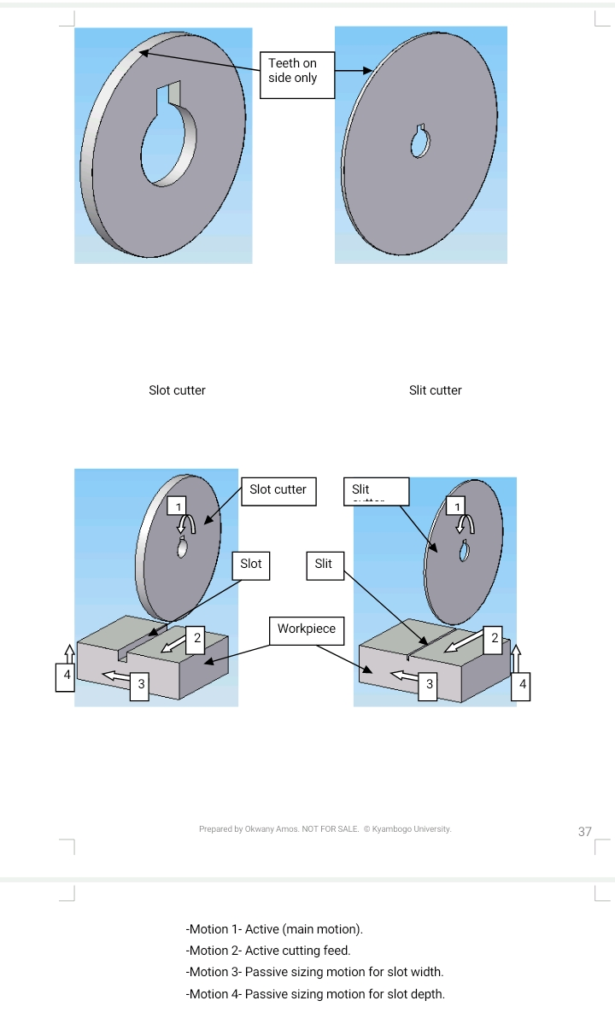
This operation produces a groove on a flat surface, using a slotting tool.
Vertical Milling Machine.
General features.
Motions.
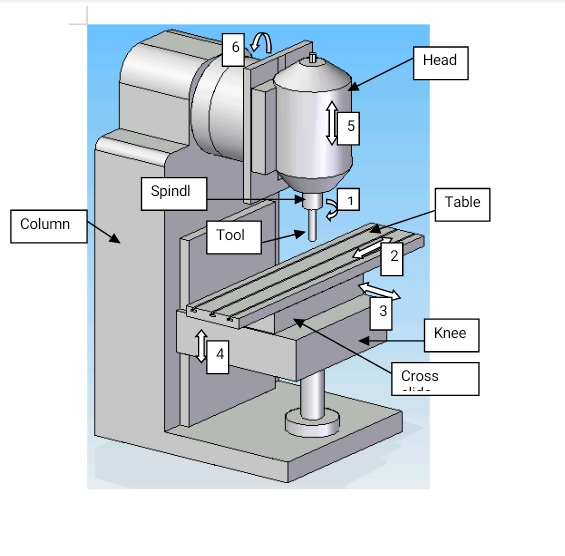
Motion 1- Rotary motion of spindle. This is the main motion.
Motion 2- Linear longitudinal motion, parallel to table surface and perpendicular to spindle axis. This motion is horizontal.
Motion 3- linear transverse motion, parallel to table surface and perpendicular to motion 2 and spindle axis. This motion is also horizontal.
Motion 4- Linear vertical motion of knee, parallel to spindle axis and perpendicular to table surface, motions 2 and 3.
Motion 5- Linear motion of sleeve, parallel to spindle axis and motion 4 and perpendicular to table surface, motions 2 and 3. Motion 6- Angular motion of milling head for setting angle of sleeve motion 5 at some angle to table surface and motion 2.
Work holding.
Work holding on this machine is the same as those used on the horizontal milling machine.
Tool holding.
The spindle nose has the same taper as that found on the horizontal milling machine. This taper takes a tool holder in which the tool can be properly secured. There are three types of tool holder and in all three cases a draw bolt is used to hold the holder in the taper, which aligns the axis of the holder with that of the spindle automatically.
Collet holder.
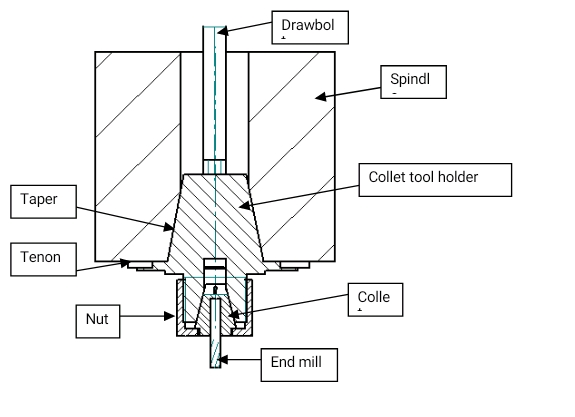
Shell End Mill holder.
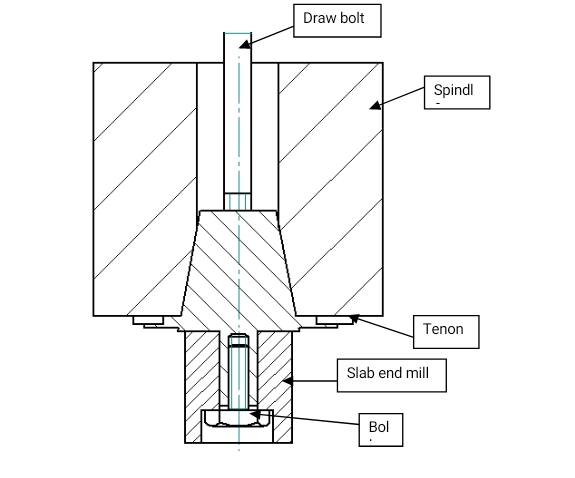
In both cases, the tool is positively held in the holder and therefore can take both axial and radial loads without coming loose due to vibrations from the cutting forces.
Adapter sleeve.
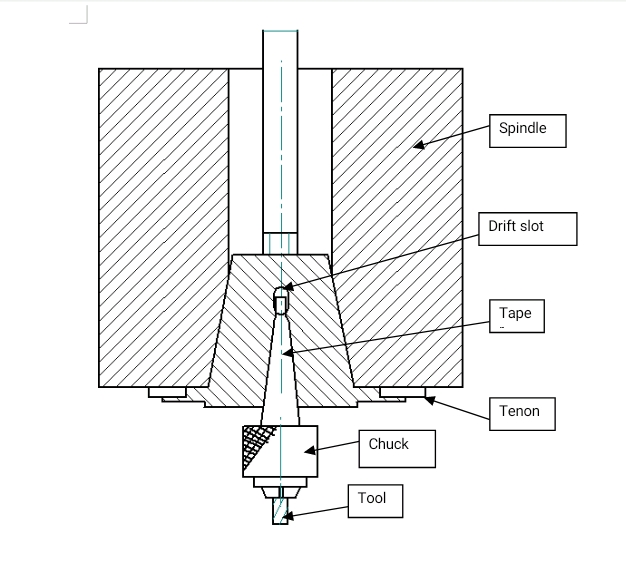
This is a holder, which introduces a standard taper at the spindle nose. The spindle is therefore able to take either a drill directly, or a drill chuck in which a tool is held. Much as the adapter is positively held in the spindle nose, its taper does not take radial load; therefore, only operations with axial tool load can be carried out using this adapter. Any radial load tends to loosen the tool, affecting the accuracy of surface production.
Operations.
The result of all operations is always a surface of some form produced. This comes about as a generated surface using single point tool or copying the form from the tool onto the work piece. In both cases it is possible to produce a surface only if at least two motions of the machine are present at the same time. These are active motions, one of which must be spindle rotation, which is the main motion. Another motion, which is very important but does not exist during actual cutting process is the one used to set the cutting depth. This is passive motion. It is the motion used to give the work piece its size.
Milling
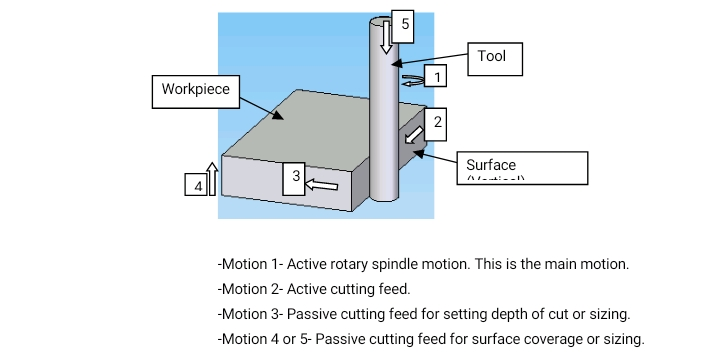
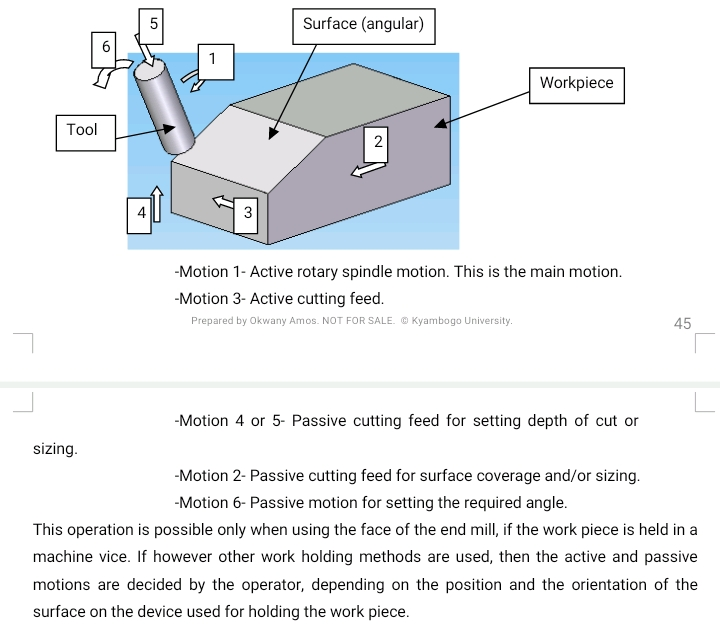
The same types of surfaces produced on the horizontal milling machine can also be produced on this machine, either using the end mill or shell end mill.
Flat Horizontal Surface.
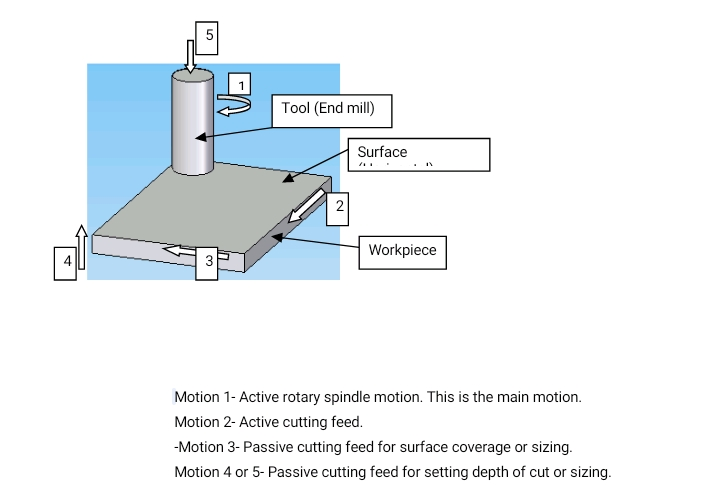
Flat Vertical Surface.
Flat Angular Surface.
Slotting.